
Have you ever been going through a really tough time and noticed how different it feels when someone truly understands what you’re feeling, versus when they just say, “Oh, I’m sorry for you”? The difference between those two responses is the difference between empathy and sympathy. When you’re hurting, a sympathetic response might be well-intentioned, but it can sometimes leave you feeling alone or even a bit judged. An empathetic response, on the other hand, can feel like a lifeline – it shows you that you’re not alone in your pain and that someone genuinely gets it. This article delves into why empathy is more effective than sympathy, especially in a counselling setting. We’ll unpack what each term really means, how empathy fuels healing connections, and why it’s so valued in therapy and beyond. (And if you’re in Perth, Western Australia, looking for support, we’ll also guide you on how to find the empathetic help you deserve.)
Empathy vs. Sympathy: Understanding the Difference
Before we explore why empathy works better, let’s clarify the terms. Sympathy and empathy are often mentioned together, but they are not the same. Sympathy usually means feeling sorry for someone’s situation – it’s a bit like standing at the edge of a dark hole where your friend is stuck and calling down, “That looks really rough. I’m sorry you’re down there.” You care that they’re hurt, but you maintain a distance. In contrast, empathy is feeling with the person, as if you climb down into that hole with them, look them in the eye and say, “I’m here with you. I understand something of what you feel.” Empathy is about genuinely understanding and sharing another person’s feelings, fostering a much deeper sense of connection and support. Sympathy, while it comes from kindness, often involves pity – for example, feeling bad for someone – without truly understanding the person’s experience.
Renowned research professor Brené Brown captures it well: “Empathy fuels connection. Sympathy drives disconnection.” In other words, empathy brings people together, making someone feel heard and included, whereas sympathy (especially if it’s just a “poor you” sentiment) can unintentionally create an uneven dynamic – one person up on the ladder offering pity, and the other still down in their pain (twentyonetoys.com). Where sympathy might create a subtle wall (“I feel for you, but I can’t relate”), empathy is a bridge (“I feel with you and I’m here with you”). This difference is huge when it comes to how supported a person feels.
To illustrate, imagine you tell two different friends that you’ve just lost your job. Friend A responds with sympathy: “Oh no, that’s awful. I’m sorry you’re going through this.” It’s a kind sentiment, but you might not feel much better – you might even feel a bit of pity from them. Friend B responds with empathy: “I can only imagine how stressful and upsetting that must be for you. Losing a job is really tough. Do you want to talk about what happened?” In Friend B’s response, they’re acknowledging your specific feelings and opening the door to listen. They’re not trying to fix it or make it go away. They’re just with you in that moment. That feeling – that you’re not alone with your pain – is the heart of empathy.
Why Empathy is More Effective for Emotional Support
When it comes to emotional support and healing, empathy has a profound impact. The reason is simple: empathy creates trust and connection in a way that sympathy doesn’t. An empathetic response tells the person “your feelings matter, and I’m here with you,” which helps someone feel validated and understood. A sympathetic response, despite being caring, might inadvertently send the message “your situation is pitiful,” which can make a person feel isolated or belittled. Empathy is more effective than sympathy because it engenders real trust between people and makes the person in pain feel truly heard and supported. Sympathy keeps an emotional distance (often just expressing sorrow for someone), whereas empathy bridges the gap by putting yourself in the other’s shoes.
Psychologically, feeling understood has a powerful healing effect. One therapeutic insight is that “rarely can a response make something better; what makes something better is connection.” When we’re suffering, we usually aren’t looking for someone to solve our problem with a clever answer – we’re looking for someone who acknowledges our pain and makes us feel less alone in it (twentyonetoys.com). Empathy provides that sense of connection. It says, “I’m with you and I understand,” which often lightens the emotional burden. Sympathy, on the other hand, might just say, “I feel bad for you,” which doesn’t lighten the load in the same way, and can even unintentionally make someone feel more alone.
Consider a counselling scenario: if a client shares, “I’ve been feeling really depressed and nothing seems to help,” a sympathetic reply might be, “I’m so sorry you feel that way. That’s really sad.” There’s kindness in that, but it might stop there. An empathetic reply from a counsellor could be, “That sounds incredibly hard. You’ve been carrying a lot of pain and it makes sense that you feel hopeless right now.” This response not only shows sorrow that the client is hurting, but also reflects understanding of the client’s emotions and the reality of their struggle. The client is more likely to feel safe and understood with the second response. In fact, empathy’s power is backed by research: studies have shown that empathy can lead to better outcomes because people are more likely to engage and trust when they feel understood. For example, in healthcare settings, empathy from providers improves patient satisfaction and even leads to better adherence to treatment – when people feel heard and understood, they’re more likely to follow through on care recommendations. People have reported that empathy and compassion from their caregiver are as important as technical expertise; many would even switch doctors if they felt their provider didn’t truly care. That’s how much being understood matters.
Empathy validates what someone is feeling. One big reason it’s more effective than sympathy is that validation itself can be healing. When a person says, “I feel hurt,” and the response they get is essentially “I hear you – you have every right to feel that way,” a weight lifts off their shoulders. They no longer have to prove their pain or feel guilty for it. Sympathy might validate the situation (“It’s bad that this happened to you”), but empathy validates the person’s emotions (“It’s understandable you feel this hurt”). That validation helps someone move forward through their feelings rather than staying stuck in feeling alone with them.
Moreover, empathy builds a bond of trust. When you respond with empathy, you’re showing vulnerability too – you’re stepping into their world for a moment. Dr. Brené Brown notes, “Empathy is a choice, and it’s a vulnerable one,” because it requires connecting with something in yourself that knows that feeling (twentyonetoys.com). It might be uncomfortable in the moment (feeling a bit of someone else’s pain isn’t easy), but it humanizes the interaction. The person hurting senses that you’re not just looking at them from afar; you’re right there with them. This trust is critical in any supportive relationship, be it between friends, family members, or a therapist and client.
Sympathy vs. Empathy at a Glance
The key difference lies in how we relate to someone else’s feelings. Sympathy means you feel for someone – you feel sad or sorry that they are going through something bad. It’s a bit like observing their situation and acknowledging it’s unfortunate. For example, if a friend is grieving, you might sympathetically say, “I’m so sorry for your loss,” which expresses pity and concern. Empathy, on the other hand, means you feel with someone – you strive to personally understand and share in their feelingspositivepsychology.com. In the same scenario, an empathetic response might be, “I can’t imagine how hard this loss is for you. I’m here with you in this.” Empathy involves stepping into their emotional shoes and seeing the world from their perspective, even if just for a moment. The empathetic person connects with the emotion the other is experiencing (for instance, recognizing their heartbreak and actually feeling a bit of that sorrow with them), whereas the sympathetic person recognizes the other is suffering but maintains a certain distance (feeling bad about the situation without truly feeling the grief themselves). In short, sympathy often communicates: “I care about you (from the outside),” while empathy communicates: “I’m with you and I understand (from the inside).” Empathy tends to be more effective in providing comfort because it helps the person feel truly seen and heard, not just pitied. That’s why, whether in therapy or everyday life, empathy usually leads to a stronger support and connection than sympathy.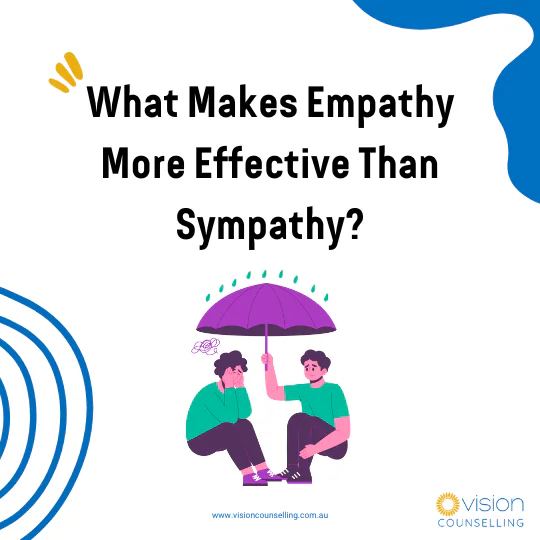
- Sympathy: “I feel sorry for you.” It often implies a degree of separation – you’re looking at someone’s situation from outside. Sympathy can sometimes unintentionally come across as pity. For example, saying “Poor you, this is so terrible” might actually make a person feel worse, as though you see them as helpless. Sympathy tends to offer a momentary comfort (“I care about you”) but then often falls silent, unsure what to do next. It does not necessarily validate the specific emotions the person is experiencing.
- Empathy: “I feel with you.” It’s the act of deeply understanding and sharing the other person’s feelings as if you were in their position (positivepsychology.com). Empathy often involves active listening and reflecting. For example: “I can hear how painful this is for you, and I’ve been through something similar – it really hurts, doesn’t it?” This kind of response normalizes and acknowledges the person’s feelings. Empathy might not have a solution to offer, but it offers companionship in pain, which often matters more than solutions. As one leadership coaching resource succinctly puts it, empathy creates real connection, whereas sympathy may only create a fleeting, surface-level interaction (gowanhealth.com).
In short, empathy is effective because it’s about connection. Sympathy, despite coming from kindness, can inadvertently create a sense of disconnection. Feeling “connected” to someone when you’re in pain – even just knowing that “someone understands me” – can be incredibly powerful. It’s often the first step toward healing or finding hope.
The Role of Empathy in Counselling and Healing
Empathy isn’t just a buzzword in counselling – it’s truly one of the cornerstones of effective therapy. In fact, famous psychologist Carl Rogers (the founder of person-centered therapy) made empathic understanding one of the core conditions for any therapeutic change to occur. According to Rogers, a therapist’s ability to accurately sense and understand the client’s feelings (and to communicate that understanding) is essential for the client to feel safe and start growing. Modern research backs this up: a large meta-analysis of 82 studies (involving over 6,000 clients) found that a therapist’s empathy was a significant predictor of positive therapy outcomes. In plain terms, the more empathetic the therapist was perceived to be, the more likely the client improved. Empathy helps form a strong therapeutic alliance – basically a sense of “we’re in this together” – which is known to be one of the best predictors of therapy success.
At Vision Counselling, our counsellors understand that being genuinely empathetic is critical. A client in individual counselling sessions should feel that their counsellor is fully present, actively listening, and truly striving to understand their perspective. If you’re seeking support for your mental health in Perth (or anywhere), you’ll likely want a therapist who doesn’t just dole out advice or say they’re sorry you’re struggling, but someone who takes the time to understand what you’re feeling. That’s exactly what empathy in counselling entails – the therapist steps into your world for a moment to feel what it’s like for you, and communicates that understanding back to you. Many clients describe feeling a huge sense of relief when they encounter an empathetic listener. “Finally, someone understands me!” is a thought that in itself can start the healing process. On the flip side, if a counsellor were only sympathetic – “Oh, that sounds so bad, I’m sorry” – and then perhaps changes the subject or offers a quick fix, the client might feel a lack of depth or understanding, and could shut down. Empathy encourages the client to open up without fear of judgment, because they sense the counsellor is with them, not judging from outside.
It’s also worth noting that empathy in counselling is a skill. Therapists are trained in techniques like active listening, reflecting feelings, and asking open-ended questions – all tools that convey empathy. A good counsellor will validate your feelings (even if those feelings are painful or complicated) and make you feel heard. This doesn’t mean they’ll always say “me too” to everything – in fact, it’s not about the counsellor’s experiences at all. It’s about the counsellor showing authentic care and understanding for your experience. For example, if you’re crying over a recent breakup, an empathetic counsellor might quietly say, “I can see how deeply this is hurting you. Losing someone you love is incredibly painful.” In that simple statement, they’re acknowledging your pain without trying to rush you out of it or plaster it over with a “you’ll be fine”. And that can make you feel truly supported.
Beyond Counselling: Empathy in Everyday Life and Relationships
Empathy isn’t only crucial in therapy – it’s the glue of human relationships in general. We all yearn to be understood by the people we care about. Whether it’s between spouses, friends, parents and children, or even among colleagues, empathy can dramatically improve communication and trust. Cultivating empathy over sympathy enhances relationships by encouraging us to really listen and engage emotionally with others, leading to more meaningful support and closeness (positivepsychology.com). In contrast, constant sympathy without true understanding can sometimes create distance. Think of a time when you were upset and a friend said something like, “I’m sorry, that’s tough,” but then went on to compare it to their own unrelated problem or just went silent. You probably didn’t feel much better. Now think of a time when someone said, “I hear you – that does sound really hard. Is there anything you need?” or even just “I’m here with you.” That second kind of response likely made you feel more cared for and less alone. That’s the everyday power of empathy.
Empathy also helps defuse conflicts and misunderstandings. If two people are arguing, a sympathetic approach might be to feel bad that the other is upset but still stick firmly to your point of view. An empathetic approach would be actively trying to understand the other person’s feelings and perspective, even if you don’t initially agree. Often just showing you understand where the other is coming from can de-escalate anger. For example, “I get that you’re hurt because it seems like I didn’t show up when you needed me. I think I would feel that way too if I were in your shoes.” This kind of statement can make the other person feel heard, and in turn they may become more open to understanding your side. In relationships, this “I understand you” moment is gold – it builds emotional intimacy and mutual trust.
In workplaces, leaders and team members who practice empathy create a more supportive and positive environment. An empathetic leader will listen to an employee’s concerns and try to feel what they feel, rather than just saying “That’s company policy, sorry you don’t like it.” By acknowledging emotions and showing understanding, leaders can boost morale and loyalty. In fact, empathy in leadership has been shown to improve outcomes: teams function better and people report higher job satisfaction when they believe their manager actually understands and cares about their feelings. Especially after the challenges of recent years, compassionate leadership (grounded in empathy) has been highlighted as key to workplace well-being.
It’s important to mention compassion here too. Empathy and compassion are closely related. If empathy is feeling with someone, compassion is taking that empathy one step further – it’s the desire to help alleviate the other’s suffering. You might think of compassion as “empathy in action.” For example, if you deeply empathize with a friend’s struggle with illness, compassion might move you to bring them a meal or help with their errands. In counselling terms, a therapist’s empathy might lead them to take compassionate actions like connecting the client with additional resources or gently challenging the client to practice self-care. Some experts note that staying solely in empathy (immersed in someone else’s pain) for too long can lead to empathy fatigue, so moving to compassionate action can actually be healthier for the supporter (gowanhealth.com). But that action has to be appropriate – guided by truly understanding what the person feels and needs. In any case, without empathy, compassion can’t really occur – you have to understand someone’s pain first. So empathy is the necessary ingredient that comes before meaningful help or solutions.
How to Practice Empathy (Instead of Sympathy)
Empathy is a natural human ability, but it’s also a skill that we can consciously develop. If you’re not sure how to respond empathetically, here are some practical tips to cultivate empathy in your interactions (these are techniques even counsellors use, and they can help anyone):
- Listen to Understand, Not to Reply: When someone is sharing their feelings or a problem, resist the urge to immediately think of solutions or what you’ll say next. Active listening is key. Pay attention to their words, tone, and body language. Sometimes just staying quiet and truly listening is the most empathetic thing you can do. Avoid interrupting or trying to interject your own stories unless it’s truly to say “I’ve been there and I understand”. Often, a person who is hurting isn’t asking you to fix anything – they just need to feel heard. Show you’re listening by nodding or saying “I get what you’re saying” or “I’m following you.”
- Validate Their Feelings: Validation means letting the person know that their feelings make sense. You don’t have to agree with why they feel that way, but you can certainly acknowledge that they feel that way. Say things like, “I can see why you’d feel upset given what happened,” or “It’s completely understandable that you’re angry – anyone would be in your situation.” Phrases that recognize the emotion – “that sounds terrifying,” “you seem really hurt,” “I can hear how disappointed you are” – show empathy. Avoid jumping into judging their feelings as right or wrong. And try not to use the dreaded “at least” – as in “at least it’s not as bad as…” or “at least now you know…”. Those phrases, while intended to find a silver lining, usually minimize the person’s pain and shut down their chance to feel understood. Empathy sometimes means sitting with the discomfort of the situation without trying to put a silver lining on it.
- Put Yourself in Their Shoes (Perspective-Taking): This classic advice holds true – imagine how you would feel if the same thing were happening to you. This requires humility and sometimes creativity. Maybe you haven’t lost a job like your friend did, but perhaps you can remember what it felt like to face a major disappointment or fear about the future. Tap into that. Dr. Brené Brown outlines this as one of the key components of empathy: try to feel with the person by recalling your own moments of hurt, so you can relate. Be careful not to make it about you though – you’re using your experience only to understand theirs, not to hijack the conversation. For instance, instead of, “Oh, I went through something similar and let me tell you all about it,” an empathetic use of your perspective might be, “I remember feeling so lonely when I went through [XYZ]; I wonder if you’re feeling some of that loneliness too?” This way, you use your experience only to connect and then bring the focus back to them.
- Stay Out of Judgment: Empathy can only occur when we suspend judgment about the person’s situation or choices. If a friend confides in you about something that you have opinions on, hold those opinions back in that moment. For example, if they made a mistake that led to their problem, resist saying anything like “Well, maybe you shouldn’t have done that.” Empathy is not about evaluating the person’s actions; it’s about acknowledging their feelings. You can gently help them reflect or problem-solve later if needed, but the empathetic response comes first. Create a safe, non-judgmental space for them to express themselves.
- Communicate Your Understanding: After listening and observing, reflect back what you’ve heard in your own words. This shows the person that not only did you listen, you truly get the essence of what they shared. You might say, “It sounds like you feel betrayed and hurt because your friend didn’t show up when you needed support. That must have been so painful for you.” When you mirror their feelings like this, it’s incredibly validating. They know their message landed with someone. Also, if you get it slightly wrong, that gives them a chance to clarify (“No, it’s not betrayal I feel, it’s more disappointment”). Either way, you’re working toward understanding. This step is essentially empathic communication – it’s not just silently understanding, but actively showing the other person that you do.
These practices take conscious effort, but they can transform interactions. If you’re used to offering sympathy, it might feel a bit awkward at first to respond in these more personal, vulnerable ways. However, the result is often a much stronger sense of connection. People who receive empathy from you will feel more comfortable around you and more confident that you truly care about them. And remember, empathy is a skill you get better at with practice. The more you make that choice to be empathetic, the more natural it will become.
In summary, empathy is like a warm hug for the heart, while sympathy is a polite pat on the back. Both come from a caring place, but empathy reaches deeper into what someone is actually feeling. By prioritizing empathy, we create space for genuine human connection and healing. If you’re going through a hard time, you might find that talking to someone who is empathetic – whether a close friend or a professional – feels far more reassuring than talking to someone who is merely sympathetic. Empathy doesn’t try to fix you or throw silver linings at your problems; it sits with you in your reality and says, “I’m here.” And often, that is exactly what we need to begin healing.
If you’re a client seeking therapy and you’re reading this, know that you deserve empathy. At Vision Counselling, we believe in the power of truly listening and understanding your story. Our team in Perth is dedicated to providing a compassionate, empathetic counselling environment where you’ll never feel like just a number or a case – you’ll feel heard, respected, and cared for.
Whether it’s through individual counselling sessions or any of our services, our focus is on walking alongside you with empathy as you navigate life’s challenges. If you’re ready to experience the difference that empathy can make, you can reach out and find a therapist who truly “gets it.” Remember, you’re not alone, and with the right support, things can get better. Empathy might just be the first step on that journey to feeling understood and moving toward healing.

