The Inner Voice That Never Switches Off
We all have an inner voice — that quiet stream of thoughts running through our day. For some, it’s a helpful guide. For others, it’s a harsh critic that never rests.
Maybe you recognise it:
- “You’re not good enough.”
- “You always mess things up.”
- “Other people are doing better than you.”
At first, you might brush it off as motivation. But over time, self-criticism chips away at confidence, leaving you feeling small, anxious, or stuck.
The Cost of Constant Self-Criticism
Research shows that people who are highly self-critical are more likely to experience anxiety, depression, and burnout【1】. Self-criticism doesn’t only affect your mental health — it also impacts relationships, work, and even physical wellbeing.
Common signs include:
- Setting impossibly high standards and never feeling you meet them
- Avoiding new opportunities because you fear failing
- Dwelling on mistakes for days or weeks
- Struggling to accept compliments
- Feeling exhausted from trying to “prove yourself”
If any of these sound familiar, you’re not alone. Many people in Perth share these struggles quietly, believing it’s just “the way they are.”
Where Does Self-Criticism Come From?
Self-criticism often develops over years. It might stem from:
- Early experiences of being compared, judged, or pressured
- Workplace cultures that focus only on results, not effort
- Societal messages about success, appearance, or achievement
- Perfectionist tendencies that make nothing feel “enough”
While you may not control how this inner critic formed, you can learn to change how it speaks to you today.
Self-Esteem vs. Self-Compassion
Many people assume the answer is simply to “boost self-esteem.” But self-esteem depends on achievement, comparison, or how others see you. It rises and falls with circumstances.
Self-compassion is different. It means treating yourself with the same kindness you would offer a friend — even when things go wrong. It isn’t about being “better than” anyone else; it’s about recognising your shared humanity.
According to Dr Kristin Neff, self-compassion has three key parts【2】:
- Self-kindness – replacing harsh judgement with understanding.
- Common humanity – recognising that mistakes and struggles are part of being human.
- Mindfulness – noticing your thoughts and feelings without being swept away.
Practical Steps to Quiet the Inner Critic
Here are small but powerful ways to begin shifting your self-talk:
- Notice the critic. Write down phrases you often say to yourself. Awareness is the first step.
- Ask: Would I say this to a friend? If not, reframe it in a kinder way.
- Practise “yet.” Instead of “I can’t do this”, try “I can’t do this yet.”
- Use grounding techniques. When self-criticism spirals, pause, breathe, and bring your attention back to the present.
- Celebrate small wins. Acknowledge progress, not just the end goal.
(Beyond Blue has excellent resources on building resilience and self-kindness.)
How Counselling Can Help
Changing your inner voice is not easy alone. Counselling provides a supportive space to:
- Explore where your self-criticism comes from
- Learn tools from Cognitive Behavioural Therapy (CBT) to challenge negative thoughts
- Practise self-compassion strategies with guidance
- Build healthier standards and realistic expectations
- Develop an inner voice that encourages, not attacks
At Vision Counselling, our team supports clients across Perth — from Scarborough to Baldivis and our Perth CBD office — as well as online. Many clients share that the biggest relief is realising they don’t have to live with the critic forever.
A Local Perspective
In our Perth practice, we often meet high achievers, parents juggling too much, and professionals holding themselves to impossible standards. They come in saying they’re “burnt out from their own thoughts.”
With counselling, they learn that self-compassion doesn’t make them weaker — it makes them more resilient.
No. Studies show that self-compassionate people are more motivated, not less【3】. Encouragement helps you bounce back after setbacks, while harsh criticism keeps you stuck.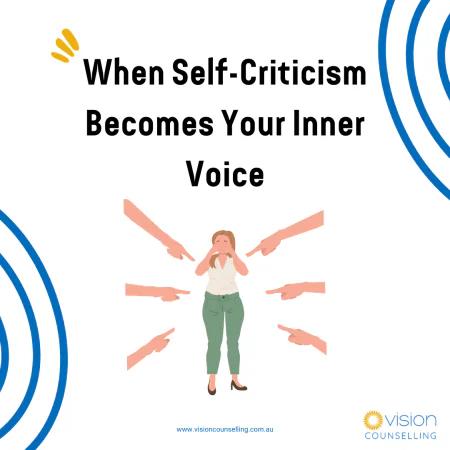
First Steps You Can Take
If this article resonates with you, here are gentle first steps:
- Keep a journal of your inner critic’s phrases and experiment with softer alternatives.
- Try a short guided meditation for self-compassion (apps like Smiling Mind or Insight Timer are free).
- Reach out to someone you trust and share what you’ve been noticing.
- Consider booking a session with a counsellor to explore your self-talk in a safe, supportive space.
(The Black Dog Institute also provides strategies for managing negative thinking.)
If your inner voice has turned into a harsh critic, it’s time to try something different.
Compassion is not indulgence — it’s strength.
📅 Book an appointment with a Perth counsellor and start building a kinder, more supportive inner voice today.
References
- Gilbert, P., & Irons, C. (2005). Focused therapies and compassionate mind training for shame and self-attacking.In P. Gilbert (Ed.), Compassion: Conceptualisations, Research and Use in Psychotherapy.
- Neff, K. (2003). Self-Compassion: An Alternative Conceptualization of a Healthy Attitude Toward Oneself. Self and Identity, 2(2), 85–101.
- Breines, J. G., & Chen, S. (2012). Self-Compassion Increases Self-Improvement Motivation. Personality and Social Psychology Bulletin, 38(9), 1133–1143.

