
Sometimes the biggest barriers people with disabilities encounter are other people. Often people do not know how to behave when meeting a person with a disability. People may feel a bit awkward and do not know how to approach the person, how to look at him/her or how to help correctly and respectfully if help is indeed needed.
In order to help overcome these barriers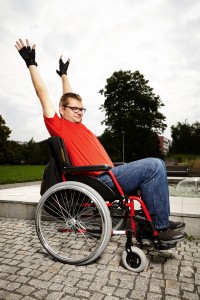 and create a sense of comfort for both parties, guidelines have been developed.
Most disability etiquette guidelines seem to be predicated on a simple dictate: “Do not assume …” They are written to address real and perceived shortcomings in how society as a whole treats people with disabilities.
“Do not assume …“:
“… a person with a disability either wants or requires assistance.”
“… rejection of aid is meant as a personal affront.”
“… upon acceptance of your help, that you know, without being told, what service to perform.”
“… a person who appears to have one kind of disability also has others.”
“… a person with a disability is dissatisfied with his/her quality of life, and is thus seeking pity.”
“… a person with a disability is easily offended.”
“… that a person who does not appear to have a disability, or who uses assistive devices intermittently instead of all of the time, is faking or imagining their disability.”
“… companions accompanying a person with a disability are there strictly to render service.”
“… a person with a disability will be receptive to personal questions, particularly in a public setting.”
“… that when a person with a disability is in a public place, that they are being escorted by a caretaker, instead of travelling alone.”
Basic tips
- Avoid asking personal questions about someone’s disability.
- Be considerate of the extra time it might take for a person with particular disabilities to do or say something.
- Be polite and patient when offering assistance, and wait until your offer is accepted. Listen or ask for specific instructions. Be prepared for your offer to be refused.
- Relax. Anyone can make mistakes. Offer an apology if you feel you’ve caused embarrassment. Keep a sense of humour and be willing to communicate.
Speaking or writing
- Refer to a person’s disability only when necessary and appropriate.
- Refer to the individual first, then to their disability (i.e. “person with disability,” rather than “disabled person”).
- The following terms should be avoided because they can have negative meanings: invalid, able-bodied, wheelchair-bound, victim, crippled, defect, suffers from, handicap, a patient.
- Avoid terms that imply that people with disabilities are overly courageous, brave, special, or superhuman.
Face to face communication
- Use a normal tone of voice when welcoming a person with disability. Do not raise your voice unless you are asked to.
- Shake hands even if the person has limited hand use or wears an artificial limb. A left-hand shake is acceptable. If the person cannot shake hands, acknowledge them with a smile and a spoken greeting.
- When planning a meeting or other event, think about specific accommodations a person with a disability might need. If a barrier cannot be avoided, let the person know ahead of time.
- Look and speak directly to the person with disability, not just to the people accompanying them, including interpreters.
- Don’t patronise or talk down to people with a disability. Treat adults as adults.
- Be patient and give your undivided attention, especially with someone who speaks slowly or with great effort.
- Never pretend to understand what a person is saying if you don’t. Ask the person to repeat or rephrase, or offer them a pen and paper.
- If requested to by the individual, offer a person with a vision impairment your elbow, to guide rather than propel them.
- It is okay to use common expressions like “see you soon” or “I’d better be running along”.
The main thing to remember is that a person with disability is just like everyone else – treat the person as you would want to be treated.
If you would like to speak with a psychologist or counsellor in Perth, you are very welcome to contact Vision Counselling and Psychology to find out more about the NDIS Counselling, and disability services.
Article Title: Disability Awareness and Etiquette Article By: Vision Counselling and Psychology, Perth Western Australia Web Address: www.visioncounselling.com.au Published: 24/11/2014 [1]https://en.wikipedia.org/wiki/Disability_etiquette (Accessed: 2014, September 5) [2]https://www.abil.org/disability-etiquette-tips/ (Accessed: 2014, September 5) [3]https://www.and.org.au/pages/etiquette.html (Accessed: 2014, September 5) Image Reference: Dollar Photo Club
